Thursday, October 24, 2013

God is Kim Jung Il

God is Kim Jung Il

I’ve spent the better part of this week engrossed in Pulitzer Prize winning audiobook, “the Orphan Master’s Son,” which chronicles the life of character Jun Do and his various exploits - kidnapping Japanese citizens, gathering radio intelligence, being bitten by sharks - as a citizen in the unfathomable clutches of the North Korean government.

The story is extraordinary - almost unfathomably so. As a young child, Jun Do’s mother is forcibly transported to the capital - the fate of all women and girls of marginal beauty. Wives are, for the most part, assigned to their husbands as tokens of reward. Doctors are functionally nonexistent, and starvation and disease are pervasive. Electricity is spotty and cuts out at nine pm. Curfew is mandatory. Anti government sentiments or attempts at escape are punishable by forced labour (and likely death) for both the perpetrator and the entirety of their family as well as any neighbours or coworkers suspected to be complacent. Government control is total and beyond the petty incursions of logic or consistency.

Earlier this week, about half way through the book and in desperate need of reassurance, I turned to a friend and expressed my doubts: perhaps the author, American Adam Johnson, had crafted a grotesque fantasy built upon our suspicions and lack of knowledge of the reclusive nation (the most isolated in the world)? Perhaps the government described were naught but the paranoid imagining of someone who’d consumed too much George Orwell. I knew only of the country’s frequent military aggressions, alongside vaguely recalled news stories of drought and poverty and difficulties with accepting aid from foreign nations. These facts did not paint an especially tender image of a land of freedom and plenty, but they certainly did not lead me to predict...this. Surely things can’t be that bad in North Korea.

With these famous last words I finished by book, a work of fiction, and set about gathering some facts.

The facts were far more disturbing than anything imagined by Orwell or Johnson. In a New York Times’ review of the book (which criticized the author’s light treatment of such a serious subject matter) the reviewer mentions, without qualification, that North Korea is the worst place on Earth. While I’m interesting in seeing the data backing up that statement (for no reason other than morbid curiousity: what other locations vied for the title? Were only entire nations considered, or also isolated geographic entities - like ice flows or volcanoes? What criteria held the most weight? In what form would the data be presented - perhaps a circle graph?), I’m inclined to agree with him. 

North Korea is batshit crazy.

In attempting to create a more cogent picture of the “Most Democratic Nation in the World,” ruled by a hereditary line of all-powerful dictators, I’m finding the task impossible - because it’s a world of inherent contradictions and terrifying (unreality?).

Rare foreign visitors, allowed on short and escorted trips to pre-approved destinations, appear stunned at both the abject poverty of the nation’s people and their unfailing devotion to the Dear Leader, whose portrait is hung in every room. A woman has surgery by a visiting foreign doctor, restoring her vision, and upon removal of her bandages she goes straight to the room’s portrait and loudly proclaims her humble thanks to the benevolence of the Great Leader, vowing to work all the harder in the salt mines. She cries with the heartfelt sincerity of her gratitude while the other occupants of the room erupt in fervent applause.

All interviews with North Korean citizens go something like this:

Question: [Absolutely anything]

Answer: By the grace and mercy of our Great Leader, whose loving benevolence ensures the prosperity of our great nation, so that I may better serve him.

Typically, the interview ends soon afterwards.

The sheer intensity of this reverence is suspicious - in no small part because it’s common knowledge that any minor misstep or perceived slight is likely to lead to death, torture, or a lifetime of hard labour in an internment camp, both for the guilty party and anyone they love. Some prison camps are strictly for the internment of family members of dissidents and defectors.

And yet, disturbingly, these spontaneous proclamations seem...sincere.

And then I thought of God - that mysterious all-loving, all-knowing magic man who comforts those who've passed on and allows all good things to happen to those who praise Him. Suddenly the fervent exclamations of the North Koreans started to sound a bit more familiar.

Good Christians know that all good things in life are by the grace of God. Grammy awards and football games are won because God wills it to be so. Wars are won in His name. And yet we are taught to fear Him and His mighty jealousy - because He’s also kind of a Jerk and very happy to send you to fire and brimstone for all of eternity because you made the mistake of being born in the wrong country or being attracted to the wrong sex or, worst of all, questioning the justice of His practices.


So, I have to give North Korea a little credit, because at least Kim Jung Il exists...

Monday, August 12, 2013

I Love You

Her mother regularly told her daughter she loved her. The words were not warm and brimming with sentiment, but rather cold and austere, as much of her mother’s communication tended to be. In the phrase, too, lay a hint of anger and defensiveness, as in I’m not like those crappy parents who never tell their children they are loved, or try to accuse me now that your childhood is bad when I have said, on record, that I love you, every day for the last ten years.

Her father, too, emphatically expressed his love for his children at the end of every conversation, stated both as a fact and a departing signature, substituting for ‘be good to your mother,’ which was awkward, or ‘see ya later, alligator,’ which the children had quickly outgrown. She understood her fathers actions better because, as an irregular parental figure, he may be days or weeks out of their lives, and she felt he sincerely wanted to leave his children with a concrete assurance of his feelings for them, lest they doubt it in his absence.

The frequency of “I love you”s was so pronounced in both parents that she eventually grew to suspect that they had conversed on the subject at least once, during that unknowable time period when they had been a couple and assumedly had conversations. Like most parenting decisions made at the time, she suspected it was a reaction to something that had occurred in one or both of their childhoods, or, at the very least, in the childhood of someone they both knew or a fictional character whose childhood was used as a parable in the church they attended, whereby both mother and father to-be learned the terrible damage that could be wrought by not telling your child, often enough, that they were loved.

They had decided or been taught that the best way to convey their unconditional love was to repeat the phrase “I love you,” eagerly, regularly, at socially acceptable intervals, such as when the child is departing for school, or at the end of a phone conversation, and she suspected that the habit of this action had eventually overshadowed the underlying intention of the act, leaving her mother’s disregard for conveying love or ensuring the feeling of love in her children, and left only the oft repeated phrase.

Like most of the values that her parents fervently persisted in, she suspected this stemmed from a cultural fad that had existed in the mid to late seventies, or general movement of social consciousness which had developed at that time and since evolved considerably so as to be unrecognizable in its present form. Like being a born-again Christian**, and the Muppet Show.

As in all things parental, the line between love, resentment, and socially-accepted obligation was blurry at best.

The mother cares for her children because she loves them. The mother cares for her children because she’s legally obligated to do so and would be judged by others if she does not. The mother cares for her children because she expects said children to acknowledge her care as a sacrifice made due to love and to never imply that such sacrifice is due to legal obligation or societal pressure, lest they be screamed at in high pitched tones, which they are to understand stems from an intense abundance of love, but also hurt and anger and dislike, because all such emotions freely coexist, as in “I love you, but I don’t like you,” a phrase which was frequently heard in her early childhood.

The daughter views “like” as the lesser version of “love,” thus negating her mothers views on the subject entirely. The daughter grows defensive of this connectedness, holding it central to her world view, becoming incensed and eventually tearful if anyone argues that the terms are not directly linked. She takes care to assure her loved ones, specifically her two dogs and sister, and her mother to a much lesser degree, that she both likes them and loves them, and she does so at intervals which are not predetermined and thus vary in frequency but still often include the ends of phone calls and times of departure.

**Christian, in this case, meaning ‘evangelical,’ just like Jimmy Carter’s sister who, if I remember it correctly, was reported as going around and performing freelance exorcisms. The fact that members of this evangelical  branch of protestantism refer to themselves just “Christians,” as though there were only one real kind, is usually enough to characterize them, at least as far as I was concerned.

David Foster Wallace’s The Pale King
posthumously published audiobook* version
(*so the spelling and/or punctuation is my own and therefore may be wonky)

Sunday, August 11, 2013

School Dress Codes are So Sexist

I’ve been on a feminist kick lately - not the act of kicking feminists, though that is a popular activity among some circles, I’m sure - but the looking at everything and everyone and proclaiming with disgust “that is SO sexist!” and then looking to other people, mostly women, and demanding that they emphatically agree. (The act of looking primarily to women to validate sexism is, in fact, so sexist.)

This started when I was reading through the classics: the Iliad and Odyssey, specifically. It didn’t help that these stories were age-old tales of rapture and pillage, that most of the female characters were war booty, and that women, at the time of the writing of said tales, weren’t seen so much as people as prized possessions with added sentimental value - a bit like a particularly loyal and well-bred battle horse. Or a favourite ram. Homer? Sexist. Trojans? Sexist. Greeks, and their gods? So sexist.

The whole world, in fact - sexist! - so much so that the Wikipedia timeline for women’s rights (which isn’t about “equality” so much as “the giving of rights to women”) doesn’t start until 1718 AD.

But even that was, arguably, a long time ago. Temporarily running low on fury, I looked to modern times and my own life in an attempt to prolong my rage.

I asked my mother, a teacher, to read to me the dress code of her high school. She wasn’t able to remember it, offhand, and couldn’t be bothered to dig it out. I fumed. I wanted references to skirt length and tank tops - items who’s name implied gender. Actually, I wanted reference to gender directly - and, depending on the age of the text and its author, I might find it. And even if I found no evidence of such language in the dress code, I felt secure in my knowledge that the high school dress code is one of the more obvious examples of good-old-fashioned misogyny in action: namely, the covering up of women so as not to unduly tempt the men. (Undeterred by my mother, who was lazy and quite possibly sexist, a short google search confirmed my suspicions.)

Sure, there might be an entire sentence or paragraph on the prohibition of gang insignia, and a dress code might readily proclaim its ultimate desire to promote the “neat and tidy” appearance of students, but in my experience this code was enforced with one goal in mind - getting girls to hide their bodies.

Stained, torn, and worn-out clothing were all prohibited by my high school’s dress code - but I never saw anyone asked to cover up a ripped or grass-stained knee. All items specifically prohibited - spaghetti straps and shorts less than one half the length of a student’s thigh - were aimed at women’s fashion.

Administrators argued that boys, too, could theoretically be affected by such prohibitions, should they come to school in short shorts or spaghetti straps (which of course could not reasonably happen as no retailer within fifty miles of Tilbury, Ontario, housed any such clothing in men's sizes). But that argument falls apart when you note that male sports teams and gym classes often allowed students to go entirely shirtless, and that a popular school comedy sketch involved our male French teacher wearing a sequined, strapless dress. It’s an obvious double standard.

Sure, I understand school systems wanting at least a semblance of decorum, of respectability. And I understand everyone’s feeling of being very, very uncomfortable upon first witnessing a fourteen year old’s thong and/or ass crack. It seems logical to want to make rules against such things. But in making and enforcing those rules, teachers and administrators inevitably end up targeting girl’s clothing and wanting women to “cover up” or “hide your distracting female form in a more thorough manner, please, because I am acutely aware that you, as a woman, have breasts.”

There’s a pretty huge historical precedent for this not being okay. These acts are grounded in the practice of men feeling attracted to women and controlling the actions and appearance of women in order to assuage said attraction. Rather than addressing men’s sexual attraction or behaviour directly, we decide to control women’s behaviour - and we’ve seen this as the reasoning behind everything from mandating bee keeper costumes and keeping girls out of schools entirely to not allowing women outside unescorted and blaming victims when sexual violence occurs. And we’re supposed to be at a point in gender politics where were refuse to tolerate that shit. 


Plus, uniforms are a pretty obvious solution if school administrators are actually concerned with the presentability of their student body.


This blog posting is dedicated to Margaret Atwood, who is the less-likeable Canadian version of Ursula K. Le Guin

Saturday, August 10, 2013

To Hurt and Be Hurt

We all, at some point, confront our own ability to both be harmed and inflict harm among others. Much of our lives can be shaped by our ability or inability to accept these fundamental capabilities.

(I say fundamental, because our ability to harm and be harmed concerns not only the most memorable and juicy bits of life, but perhaps also life itself. We are; in being we inflict ourselves upon the world around us, often upon the other beings existing around us. Thus we harm. Inevitably, too, the world around us hurts us - inevitably, some of those blows prove fatal. And so we are harmed.)

A couple weeks ago, I was escorting a man in the deserted upstairs hallways of the building where I worked. He was irritable, but that quickly turned to anger. He started yelling at me. Then, while yelling at me, suddenly he was holding an Xacto knife (American translation: box cutter) in his right hand, the blade exposed. “I’m not brandishing this,” he yelled, and then continued to yell, the knife exposed, until he turned his back to walk away and I darted behind a locked door and burst into tears.

The man would later appear incredulous and incensed at my (mis)interpretation of events: “I told her I wasn’t brandishing the knife!?” And I felt especially bad, because he’s gay, and it was Pride Week, and the whole situation felt very awkward - which just goes to show that even traditionally victimized people can be terrifying when holding knives whilst yelling at people. (...Progress towards equality? Yay?)

When relaying the tale to other staff members, both immediately and in the week that followed, all made attempts to be supportive, most of them genuine and heartfelt, some above and beyond. The only exception was a woman who found herself with two conflicting thoughts which could not, to her, coexist: the man was nice and she liked him vs. the man was holding a knife while yelling at Ivy.

I, too, liked the man - a little less so, now, but I wished him no ill will. I knew this action was out of character - dramatically so - and that it was proceeded by several months of declining mental health. But when I tried relaying that the man must have pulled out the knife (as he had not previously been holding it) and that the blade was exposed, this coworker interrupted:

“No.” She said. “Just - no. I can’t believe that happened.”

I’d encountered this same attitude when a former coworker slash former mutual friend had begun hitting on me and, after I declined, repeatedly yelled at me and behaved in a generally jerkish and intimidating manner. Despite admitting to having witnessed his yelling at me, she emphatically proclaimed that he didn’t really mean it, that I had misinterpreted everything, and while she was sad I felt that way, he was such a nice guy and he would never do anything to anybody.

She also said his yelling at me was kind of my own fault for not having responded to an email he sent me wherein he said that he was sorry that my stepfather had died.

No...just, no.


Whatever cognitive dissonance was occurring, it seemed to be about accepting that nice people sometimes do shitty things - that we, as adults, as people, are capable of hurting those around us. The response to which doesn’t have to be self hatred and flagellation, even - only acceptance and, maybe, hopefully, learning and attempts at reparation. And probably a stoppage to the yelling and wielding of knives. If that's okay.

...Please stop yelling at me.

Monday, July 8, 2013

Liver


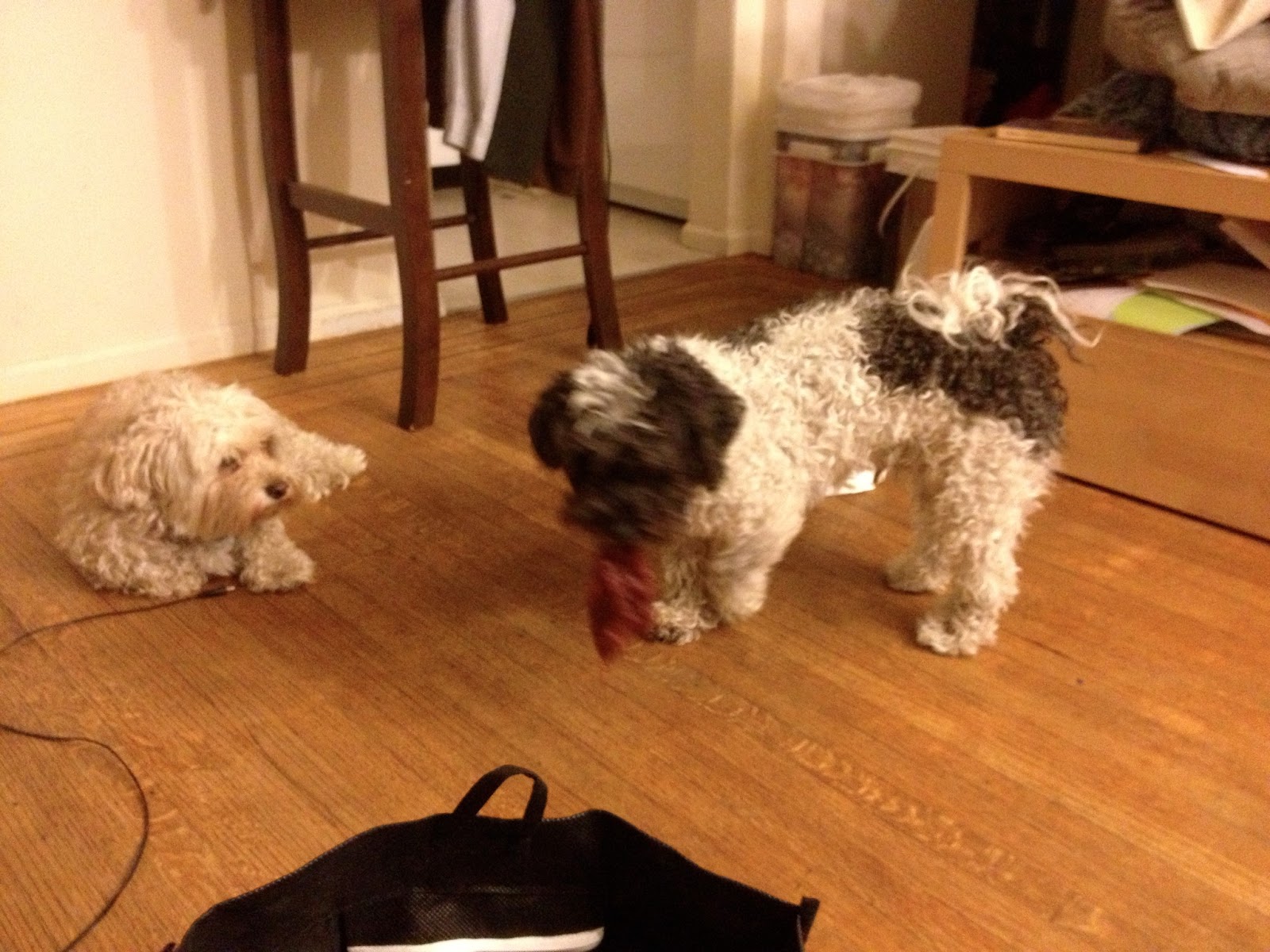
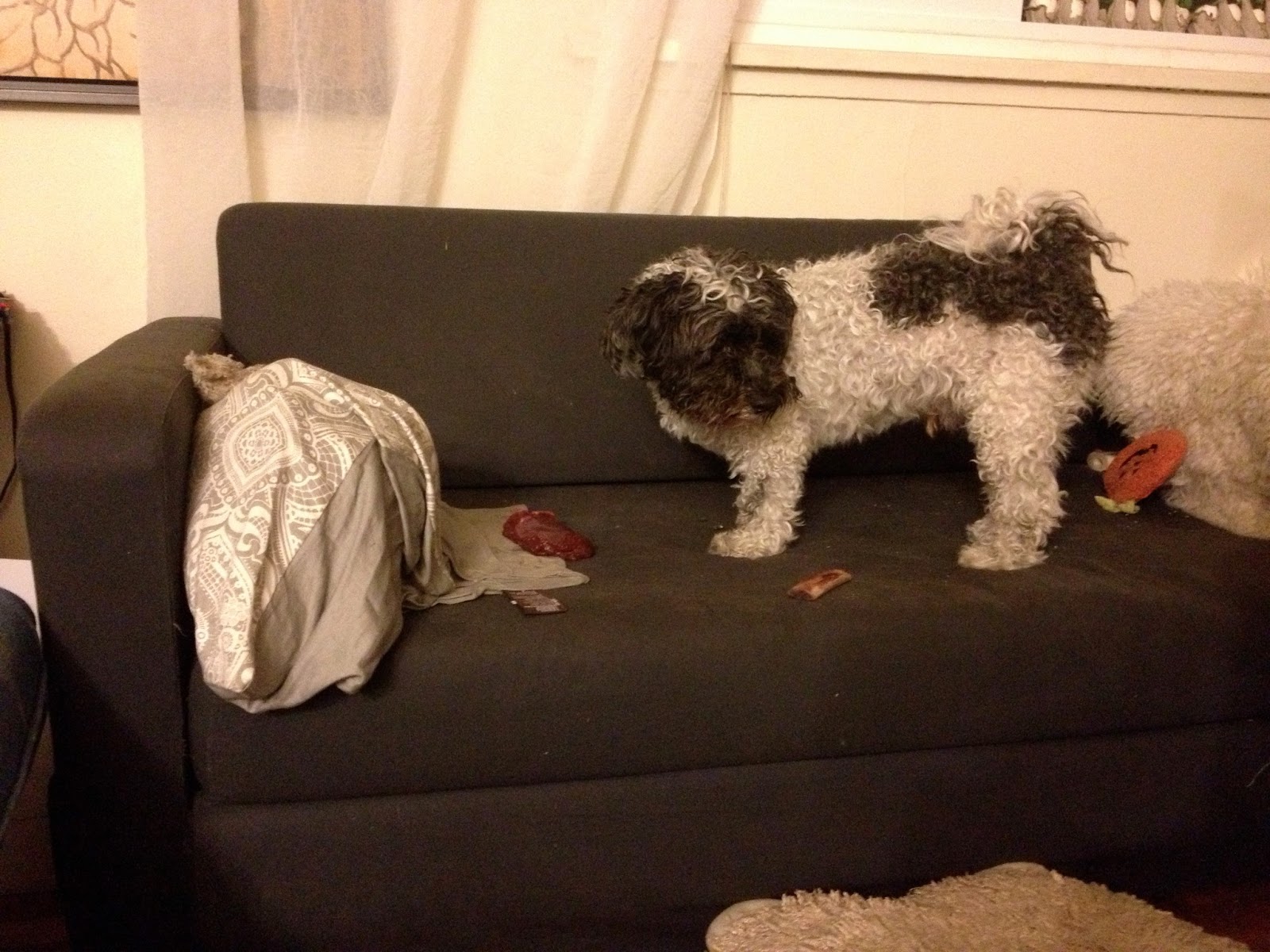
The following is a partial transcription of my half of conversation occurring largely via text message earlier this evening, and supplemented by photographic evidence to better document the disturbing nature of what occurred:

I just had to rip apart a cow’s liver and it was disgusting.

Sad face.

...Why? I don’t know anymore!! It squished into liquid and the smell and I can still smell and I can still smell it! SAD FACE!

And Mustard keeps taking the liver out of the dog dish and laying it on the couch to...sit. And ooze liver into the furniture I love. And Mustard won’t actually eat the liver because it’s Toby’s liver, but Toby won’t eat the liver because Toby realizes that liver is not food. It is NOT food. It is a gross blob of ew.

Seriously, this has happened about six times. I keep moving the liver back but I have to use a giant wad of paper towel to touch it because the smell...

(Also I ran out of my regular dog food and everything went downhill from there.)


I can rip a steak in two. It’s easy. Because a steak doesn’t liquify in your hands and ooze between your clenched fingers and the smell...oh the smell. I washed my hands like five times and I can’t get the smell out.

It’s sitting on my couch right now. It’s an amorphous gelatinous blob the colour of rust. It’s like...have you ever seen a beached jellyfish? It’s like that. Or a placenta.

Pictured below: three terrifying things.
 

Saturday, June 29, 2013

A Dolphin Tried to Have Sex With Me

It all began with the movie Red Hill.

Now, I am not saying that this modern western tale of betrayal and revenge is a great movie; objectively, it may not even be a good movie. But I can say without hesitation that my experience, watching it, was nothing short of a spectacular, and upon finishing the film and subsequently telling everyone I knew that they must too experience its wonder and glory, I found that I had changed. Red Hill had awoken something inside of me that had long lay dormant. Suddenly I remembered, with marked clarity, a desire that had last been voiced when I was no more than a seven or eight year old girl, wearing pigtails: I wanted to ride a horse.

Now, being a practical woman, I found myself painfully aware that riding a horses costs money. Not having a huge sum of money to spare, and feeling the guilt of spending said money on sudden horse-riding whimsy inspired by Australian B-movies, I hesitated. Perhaps my dream of riding majestic Fudgesicle into the sunset, the wind in our respective glossy manes, was not to be. Perhaps some fantasies are best kept to oneself.

And then an idea struck me like a thunderbolt: Staff Appreciation.

My employer has a longstanding tradition of showing gratitude to its employees in various ways, one of which is an annual outing to a random destination to engage in an activity which is, theoretically, designed to build camaraderie among staff. While I know of this tradition, I have not experienced it firsthand, and despite almost four years of full time labour I have yet to know the joy of, say, kayaking with my boss and coworkers on a frigid winter lake. This knowledge has long sown bitterness within my soul, so that I grew avoidant of the topic, lest I feel the pangs of thankless drudgery.

But now, suddenly, a golden - nay - palomino opportunity lay before me.

I would ride a horse, and I would do it as part of my long overdue Staff Appreciation Outing. My employer would pay me to  fulfill my newfound equine fantasy. And it would be magical.

I will not say exactly how I lay my plan in place - how I convinced my coworkers, one of whom was traumatized by a childhood horse attack and now suffered from a crippling equinophobia, another of whom was deemed medically unable to ride a horse due to lower back surgery - to band behind me with unanimous support.

How too I convinced my employer, who for years had avoided any such events, to commit to a date and activity, I cannot say for certain. It was a long, laborious process. Many times, I came close to giving up. And then I thought of Red Dawn, and about the noble police officer determined to defend his town and discovered the truth, at all costs, despite repeated serious injuries, a violent gunman on the loose, and almost being eaten by a panther.

Giving up was not an option.

And somehow, six months after my plan’s inception, I saw it finally at long last coming full fruition, and the very next day, Wednesday June 26, I was booked to go horseback riding in the British Columbia mountains with my coworkers, at no cost to myself.

And then my boss said, with a “what can you do” shrug, that he had cancelled Horseback Riding, because the weather app on his phone told him it was certainly going to rain. Instead we would have a staff meeting and then maybe we’d do something else.

I blinked, and heard the distant neighing of noble steads fall silent.

...

To say that my mood was poor, during the morning staff meeting of Wednesday June 26, would be an understatement. It started out with my spilling my coffee all over my coat, which was unfortunate, and had the side effect of robbing me of vital caffeine. The meeting ran long, and when asked about staff appreciation that afternoon, the usual cacophony of half-baked ideas and vocal dissent ensued. I feared no consensus would be reached. I knew that nothing would compare to my plan, so close to fulfillment, so cruelly quashed. Someone suggested we go bowling.

I could feel a stinging pang within my chest, and I knew that my heart was breaking.

I excused myself to the washroom and took an antacid, because heartburn also causes stinging chest pain, and when I returned to the room my coworkers informed me of the plan made in my absence.

We were going for lunch, and then to the aquarium.

In retrospect, some or all of the sadness I felt may have been the result of low blood sugar, because lunch helped my mood considerably. Upon arrival at the aquarium, my disappointment had all but faded away entirely, because: Sea Otters and Jellyfish.

And then there were penguins. And two orphaned dolphins. (I strongly object to dolphins  and whales in captivity, because of the movie The Cove, but these guys were orphaned and rescued as babies and thus lack the life skills they’d need in the wild, so my guilt was assuaged.) I discovered that I could play peek-a-boo with my new dolphin friend, and he seemed to enjoy it. A lot.

...
...

And that is the story of how I saw my first erect dolphin penis. Because apparently I am arousing to dolphins.


Sunday, June 2, 2013

Behavioural Neuroscience and Hannibal: the TV Show

Subtitle: Why Is No One Giving Will Graham A Hug?

Most readers won’t know this - as most people in my life don’t, so it would be weird if you did - but I originally attended university in the hopes of pursuing a degree in behavioural neuroscience. This, of course, was just a fancy title to put on my application to med school, where I hoped to pursue a specialty in emergency medicine or psychiatry, but plans went terribly array so that’s neither here nor there.

What ended these plans was a bout of serious depression and my withdraw from my undergraduate program, my hopes of becoming a physician, and finally university altogether. I likely knew, even before I enrolled, that I was suffering from a mental illness - stemming from a sensitivity drawn out in my dna and prenatal environment, and set into motion by a childhood bathed in neglect, trauma, and periodic abuse at the hands of others, who were also, in their own right, traumatized and mentally ill. Why else would I have pursued a profession so tied up with my own experience? But this knowledge was never explicit and I avoided, as long as I could, any of its terrifying implications.

But this post wasn’t supposed to be about me. Hmm. Let’s get back to Hannibal and Will.

Hannibal, the character, is a spectacular psychopath - the sort of monster who fascinates and speaks to dark curiosity and sense of the macabre. We want to know why and how he does the (fictional) things he does. This dark wonder has led to four novels and six movies in which Hannibal is a central character. (Only five? What? Instinct WASN’T the story of Hannibal Lecter’s cunning evasion of police through posing as an anthropologist studying a remote band of highland gorillas and finally discovering, in them, the sense of community he never experienced was his fellow man? WHAT?!) And this year, those watching NBC’s Hannibal have discovered a new version of Empire Magazine’s Eighth Greatest Character of the last twenty years.

Hannibal the Psychiatrist’s intense sense of enigmatic evil is matched only in the sheer adorability of central character and muffin Will Graham - the instructor turned special investigator for the FBI who is described as having an empathy disorder akin to “the opposite of autism.” He is easily drawn into the world of others, seeing into their experience with an uncanny intuitive clarity which leaves him, after, feeling shell shocked and terrified. Will sees through the eyes of brutal killers - feeling as though he himself may have committed their crimes - and uses this skill to help stop them from killing again.

So why bring up my history at all, you ask? Why describe myself in a paragraph next to what could be seen as praise for the most notorious fictional serial killer of all time? That seems like a weird and potentially incriminating thing to do.

I bring up me only because my history, education, subsequent work* in mental health, and unending curiosity regarding neuropsychiatry has made watching Hannibal a special kind of torture.

*I work with adults with psychiatric disabilities as a community mental health worker for an innercity non-profit - many of my clients struggle with homelessness and addiction. But I don’t work here because I’m trying to pray on society’s most vulnerable a la Hannibal. Because I’m not. Oh god I’m just making it worse aren’t I.

In this week’s episode (spoiler, obviously), it is revealed that muffin-face Will Graham is suffering from anti-NMDA reception encephalitis, a rare disorder which is, in the show, described as degenerative and untreatable. Not that they try and treat it - Hannibal and a surprisingly complicity neurologist are both happy to leave Will without even the knowledge that he’s suffering from an illness, all the better to watch him de compensate and study the path of his downward trajectory.

Also mentioned this episode are Mirror Neurons - a type of cell in the brain which reacts identically when viewing a behaviour or preforming a behaviour, believed by some to play a role in human empathy. This connection, however, is dubious at best and very poorly understood - Hannibal may or may not know this, and it may or may not be sloppy writing.

Cotard’s delusion, spatial neglect, prosopagnosia - all fascinating neurological symptoms featured in this week’s episode and distorted by both Hannibal the character and Hannibal the TV show to best achieve their nefarious means. Their goal is, of course, to ensnare their hapless audience - Will Graham and myself, respectively. We are told only distorted fragments of the truth.

(Speaking of the truth, anti-NMDA reception encephalitis is often a form of paraneoplastic syndrome - a reaction of the immune system in response to underlying cancer cells elsewhere in the body; see House for further details. It occurs almost exclusively in women and leads to death or permanent neurological damage in about a quarter of its patients - the other 75% make a full recovery.)

Up until this weeks’ episode, I had rejected the possibility of a neurological diagnosis for Will. Others had not, proposing any number of strokes and tumors which could have resulted in his specific symptomatology. I clung, wrongly, to the belief that Will, like so many others, was reacting as best he could to an onslaught of trauma outside of his control. He dissociated (like a soldier going through the motions amidst an onslaught of horror in battle, later having no conscious memory of events). He misinterpreted ambiguous stimuli (like the PTSD sufferer who’s hyper-vigilance leads them to jump at the slightest movement, or the abused child who hears distant laughter and interprets it as screaming). He suffered from night sweats, headaches, and nightmares (like...everyone when stressed out or traumatized, I think?).

Will had, previously, shown all the symptoms which I believed to be characteristic of stress, and our minds' spectacular ability to protect itself from that which we feel we cannot handle. Will’s symptoms were extreme and increasingly terrifying, for both himself and the viewer - but not outside of logical possibility. This is what trauma survivors do. We tune out, and repress, and distract ourselves endlessly in an effort to avoid overwhelming emotions.

We write three-page long blog articles on obscure neurological conditions and the character Hannibal Lecter, all in an attempt to avoid finishing an episode of a TV show because Will doesn’t know he has encephalitis and is sad and afraid and WHY IS NO ONE GIVING HIM A HUG???

Ahem.


I return to my video player with an increasing sense of unease.

Wednesday, May 22, 2013

Death, Cancer, and Sexy Organs


If we live long enough, we’ll all eventually get cancer. On a long enough timeline, we may all be struck by lightening, too, and an infinite number of monkeys on an infinite number of typewriters will reproduce the works of Shakespeare (except that all the major characters will be monkeys and there will be much more flinging of feces), but these scenarios are all very abstract. We don’t have infinite time. We have years, decades, some of us more than others. And within that time frame, cancer can and will appear.

If you need proof of this, look only to your testicles (or, for women and eunuchs and testicular cancer survivors, look to your metaphoric testicles). Relatively complex organs geared towards reproduction and surging with exciting bodily hormones, testicles are a prime location for the generation of errant tissue and, in fact, testicular cancer is all but guaranteed for men who live to the age of 80.

(This isn’t actually a health problem, because your average 80-year-old will die long before their testicular cancer has any negative impact on their health. Which is why routine screening for testicular cancer in senior patients is no longer advised. The more you know.)

Looking for the female equivalent of the time-bomb-esque testicles, we find the breasts and the ovaries - sexual organs whose cancer rates are similarly high. Ovarian cancer is known for being deadly (as it has easily ignored symptoms and cannot readily be screened for), and breast cancer is known for being a giant pink clad diva which hogs air time and funding dollars. (All the other cancers are jealous of breast cancer.)

Every period a woman has elevates her risk of breast cancer, and so, for fertile menstruating women, that risk is steadily rising over time. Women in time’s past had it easy, what with constantly starving, being pregnant, and/or breastfeeding, cutting their overall number of periods and thus their breast cancer risk. Not so for today’s women, who’s rates of breast cancer have never been higher.

(Sidenote: this link between overall number of periods and breast cancer risk is a constant source of odd demographics and perplexed news articles: Earlier periods linked to breast cancer! Eating ice-cream regularly linked to breast cancer! Childhood obesity linked to breast cancer! More sex equals less breast cancer!

Childhood obesity can cause earlier onset of puberty, which means a larger number of periods over a woman’s lifetime. Having a certain amount of body fat and dietary fat is necessary for women to menstruate, hence more ice cream equals more periods. And sex is linked to pregnancy, which lowers a woman’s risk of breast cancer by filling her womb with fetus, causing fewer periods.)

The point of which is: I found a lump in my breast and had to go for an ultrasound and it was really scary. It wasn’t cancer, it was just lumpy breast. But it was scary. I’m glad I don’t have cancer.


The end.

Sunday, December 9, 2012

To Love a Pen


To the Pen, which sits on my kitchen table, whom I formerly held in such high regard,

I have lately come to hold the opinion that you are, I dare say, a bad pen. A loathsome pen. A pen which has, instead of fluid ink, naught but malice at its core.

Further, I believe you take great pleasure in your undermining of my manhood, and my intentions, and it is in this action that I have come to know your true, despicable nature. You are a foul and wicked pen.

You will recall, surely, that it was but a short while ago when I felt quite differently towards you - when I had showered you with nothing but genuine affection and made known to you my high regard for your penliness.

“My sweet stillo,” I would call you, for I did at the time see nothing in you but sweetness, and kindness, and how verily I was deceived.

In repayment for my affections, you have ruined me, pen.

I must ask, rhetorically, for I know you will not see fit to respond to my pleadings with anything but cold disregard, what I did to incite such unkindness in you, for in my recollections I have only the memory of loving feelings and acts of devotion towards you. Did I err in the execution of my doting, or fail to communicate my friendship, nay, my love? For I think I did love you, pen. How I loved you.

I would often think upon your graceful form, your ready mark, your yielding flow of jetty  ink. Some nights I would lie awake, kept up by the stir of your being, so immense was my generous affection. I spoke of you often, and kindly. I sometimes, even, would forgo the warmth of meals to look upon you with aching tenderness, to recall the sensation of your steely body in my steadfast hand.

I asked nothing of you in return, pen, except that you acknowledge me. I think we both know that I deserved much more than a reply, but that is all I asked of you. Oh, scrawling  former love, how cold your steely shaft now seems, when I recall that you did not see fit to answer me, to look at me, to recognize the undying affection within my very soul. You would not see fit to honor me with even this basic act of dignity, after all I had done for you.

How can you think it right, to act this way?

My bleeding heart wails at the injustice of your spurns. How can you do this to me? Why don’t you love me, pen? Why? Am I not man enough for you? Have I not labored long enough in earnest regard to have earned even the smallest kindness? Do you think yourself better than me? You loathsome, vile thing!

A great disquietude sits within me, knowing of your wickedness, and how you so readily acted against my heart, my person, my being. I have often, in these hard days, wondered at your deceit, your silence, your resolute disregard, your reasoning in wounding me so deeply.

It is all now becoming very clear.

Yes, I think we both know of the state of your soul - for from whence can such cruelty erupt but the blackest of infinite chasms, the darkest depths of Hades itself, where remains no fiery heat or torrid screaming, but only icy bitterness and hate.

I know better than to expect a response from you, now, and it would bring me no pleasure to see you plead with me, to whimper and beg, to vow that you now felt differently.

I am doing the world a great service, now, and setting my heart upon a path of healing and, God-willing, eventual recovery - for there can be nothing right in the world where a pen like you remains.


Saturday, December 1, 2012

How to Lose Friends and Alienate People


"Aw, this is pretty. I like pretty things," says an unsuspecting acquaintance,  seemingly oblivious to the awkwardness that awaits.

"You should see my house!" I respond, a little too eagerly.

"What’s in your house?"

"Well, my main room didn’t have the best lighting. So I had to install some bulbs, and so I put a big tree on the wall, with the lights in the tree, and the wires as vines running down the tree...it’s all very celtic and mystical, it’s really quite nice. And then there are clouds. And a dragon."

"...A dragon?"

"Yes, a dragon. And that’s the one wall. And then the other wall has an octopus, and jellyfish, and a sea urchin..."

"...I fear you."

"Oh, and on the other wall, there’s the explosion of the universe."

"...Dear god."

"It’s pretty! I made it out of shiny paper and bristol board."

"...Never speak to me again."

Thursday, November 29, 2012

Skytrain Single Mom


When I walk into the skytrain station, I see a small, dark person, and a tiny, blond child. The child is maybe three but still with the stature of a toddler no more than two, and the larger figure is hitting him or her across the face - slap, slap, slap. After the fourth slap, the little child cries out in a defensive wail.

I want to intervene, but I remembering living in Thailand, where babies and children are slapped, not spanked. I cringe, because cross-cultural interventions scare me, and because I don’t know how to tell someone that it’s not okay to beat a child. Walking away, I see that the person I thought to be an adult is an older child. A sibling. I try and relax. I hit my sister all the time. She turned out okay. Suddenly the mother appears, whacking the older girl upside the head and grabbing her arm in tow.

On the train, they take up three rows, each alone alongside their luggage.

Crossing over the Fraser River, the the mother turns to her older daughter, “I thought you said the train went under the water.”

The girl looks around, and then turns, thoughtfully, “no, the other water, on Granville, that’s where the train goes under the water.”

“Well, the train just went over the water.”

“No, mom,” the daughter explains, with pauses and gestures, about how she hadn’t been thinking about the Fraser River, which we’d just passed over, but about False Creek, a part of the ocean, under which the tracks would later pass. The mother bristles defensively, and explains that, well, she just thought, cause she saw we’d passed over the water, that maybe she was wrong...

I think of my coworker, who grew up abused, and smoked crack in the bathroom while her tiny children sat on the other side of the door and cried. Her children are teenagers now, and she tries with all of her being to be the parent she never had, but barks defensively whenever she feels threatened, which is often. I think of how lonely it must be, just wanting to love and be loved, but to alienate everyone by oozing anger and hurt from every pore.

I think of the older daughter, and how adult she seems, and I wonder if she’s even ten. She has the weight of adult responsibility all over her face.

The mother is checking the map, and checking the signs. The mother and daughter argue over which stop is which. A food bank is mentioned. The tiny child makes eyes at me - giant, saucery eyes. He says something which comes out “bla wa wa wa wa” in perfect monotone. I smile and make my mouth big. He repeats his cryptic sentence, then turns away.

After yet another trip to the map, and discussion of stops, then worried glances to see what station we’re at, I decide to intervene.

“Which stop are you getting off at?” I ask, and the mother and daughters turn, a bit taken aback.

“The man said, Broadway City Hall.” The mother says, regaining composure.

“Okay. That’s the next stop. This is King Edward, and then the one after that is Broadway City Hall. But you have a few minutes - the stops aren’t too close together.”

The daughter is grabbing bags, and then returning to her seat, and then grabbing bags again. They discuss where to catch the 99 bus.

“Don’t worry,” I say, again interrupting, “the bus stop is right outside of the station. Just right out front. You can’t miss it.”

“Thank you.” The mother looks at me, and then at her daughter, and back again. “I don’t like traveling at night.” I nod. “I rely a lot on her. I don’t like to rely on her, but...”

“Yeah, but it’s nice to have a buddy. I hate transit - especially when you don’t know the route too well. It took me months to get comfortable.”

At this, the small child is up again, looking at me, and meaningfully telling me something that I cannot understand.

“Oh, he says, we were on the ferry, up top.”

“Oh!” I reply, suddenly understanding, and feeling terribly guilty. “On the ferry! Did you like it?”

“We were on a truck and then a ferry up top something something Grandma.”

“Wow! And now you’re gonna go on a bus!”

At this he smiles, and then shakes his head dramatically, at which his mother laughs. The older girl is standing next to me in the aisle, lugging a suitcase with a blond-haired doll on top.

“We’re going to my grandma’s. This is her doll. It’s an old doll.”

“Oh, it’s beautiful. Is it porcelain?”

“Yeah.”

“It’s really nice.”

The troop departs. The tiny child is competently lugging a suitcase in the wrong direction, and is yelled at, then trots back to his mother and sister at the elevator. The mother smiles and waves at me, and I wave back. Ten seconds later, the girl turns and sees me and waves, and I wave back, and the skytrain pulls away.

Sunday, February 19, 2012

War Horse, or "Animals Being Harmed, the Movie"

It’s Oscar season, which is time to reflect upon the movies - good, bad, and horrible - that have come and gone in the year that’s past. There are many surprising gems nominated for best picture, and there are some giant, festering turds, too, and too many snubs to count. It’s the way of the Oscars - beautiful, bedazzled, severely retarded award show that she is.

It’s only in measuring up my favourite and most loathed movies of the year that I’ve come to an odd realization - War Horse, Project Nim, and Rise of the Planet of the Apes are all kind of the same story in different forms, despite one of them being a badass blockbuster, one been an art-house documentary, and one a terrible Spielbergian schmaltz-bucket. (In case those adjectives were unclear: War Horse is a bad movie. Don’t see War Horse.)

Each movie has an animal in the starring role. Each animal is used and traded by various humans for their own gains, and while there are good, caring humans, and there are bad, callous humans, they’re all cogs in an unsympathetic system that cares not for the animal’s fate. We see the animals abused, neglected, scared, and horribly alone. And only in one movie do we get to see that animal plot his revenge and wage war against his oppressors, humanity, giving us a cathartic victory instead of gnawing void.

Spielberg has made a long career out of taking heartbreakingly sad events in history and making them unbearable sentimental and three hours long. It’s cheesy, and it’s unnecessary, and it’s our own damned fault, because we keep giving him awards.

Schindler’s list was a good movie, sure, but did Liam Neeson sobbing “I could have saved one more...and...I didn’t!” (a scene which has no historical origins) really enhance our understanding of the Holocaust, or his character?  And do we really need a chained African man in an early American courtroom shouting, “Give us us free!” over and over again, while the orchestral music swells, in order to get that slavery is wrong? And don’t we already all know that World War One was terrible, pointless, and wrong, and even have a universally acclaimed movie to illustrate the point? Can’t you leave that one alone, Spielberg?

These are all rhetorical questions, I guess, because All Quiet on the Western Front still exists, but so does War Horse.

It’s World War I, told through the eyes of a helpless animal in the most cliched way possible, so that Spielberg can teach us all that the Great War was sad and innocent people died and got hurt for no good reason. Which we already knew. Thanks.

And despite it’s unabashed corniness and deliberately sentimental plot, I cried.

Why? Because the damned horse watches his best friend die in front of him, in the mud, having been worked to death hauling artillery to the front lines, and our titular horse tried to save him but couldn’t, and now watches him die and then looks on with giant horse eyes clearly portraying a sadness and grief which can never be properly explained or understood, because there is no explanation for why, or how, this all happened, or how the world could ever right itself again...and I’m not made of stone, people. It’s sad.

...And then, moments later, the horse gets spooked by a bomb, then a tank, and runs, panicky, into the front lines, where he gets hopelessly tangled in barbed wire. And then it’s not so much sad as cruel, to the animal and the audience, and I feel more pissed off than sad. Because the movie is clunky, and manipulative, and despite its aesthetic beauty (it really does have nice cinematography), it left me feeling abused.

So abused, in fact, that I couldn’t properly put my emotions into words. So I made up a picture, instead.


This is what comes of watching War Horse. 


Tuesday, November 29, 2011

I Know a Convicted Sex Offender Who Might Be Dead...a true story


The other day, I was notified that one of my thousand-or-so clients had gone missing. Which is a sad, but not infrequent occurrence - many of the people who use the drop-in centre where I work are homeless, and almost all struggle with mental health and addiction issues. Within a week or two most turn up, alive, not too much worse for wear. Some do not.

The man in question was a regular volunteer, and I felt particularly saddened to learn of his disappearance - my interactions with him had always been pleasant. A shorter, chubby-faced man, he’d always seemed sweet and eager to please; a little slow, maybe. Not the sort of person I’d associate with the seedy underbelly of society, or heroin addiction. Not the type to disappear and reappear casually without causing concern.


The more days passed, the more I worried about this guy.


Finally, today, I google searched his name, hoping that he had turned up days ago and that my colleagues and I had simply failed to be informed - the sort of thing that happens in the social services world all the time; we’re all too busy, the squeaky wheel gets the grease, and bad news travels seventeen times faster than good news, according to the laws of idle gossip.


I also knew that my google search might turn up news that was far more upsetting - a body, maybe, or evidence of suicide. Tending to believe that any news is good news, and that I’d rather know than be left to wonder in the dark, I’m the type that regularly seeks out potentially awful information, even though many wise individuals have advised me that this strategy is incredibly stupid. And they may have a point.


I searched, and I found absolutely nothing to do with my client’s current whereabouts or anything related to his disappearance.


Instead, I found dozens of articles, years old, related to his release into the community after serving a lengthy sentence for committing a very violent sexual assault. Against a young woman, who was a stranger. Who he brutally assaulted, tried to kill, and then left for dead, unconscious in the woods, bones broken, eardrum pierced, her face requiring stitching from mouth to ear.


Considered a very high risk to reoffend, police released him back into the community because they had no other choice - he had served out the entirety of his fourteen year sentence. And during that time, he had stalked and had unwanted contact with several women, breached probation twice, and escaped once. He was found the next day. His parole board spoke of his release with grave concern.


Several communities had banded together to keep him out, and so he ended up here. Literally, here. As in, two blocks away. Or, right next to me, holding a knife, chopping onions, depending on the day.


Which...I’ve known some terrible, terrible people. People who have harmed those I love, who take pleasure in the pain of others, and who deserve nothing but the caustic flames  of hell and eternal castration whilst being raped by a bear. There are people I feel no sympathy for, and likely never will.


But this client isn’t one of those people. And I can’t help but try to preserve my image of him; as a 
polite, somewhat-slow, nice guy.


While this is the most graphic and well-documented case I’ve yet to encounter, I know that many, if not most, of my clients have done things in their past which are horrible, abusive, and wrong. Hell, most people I know, when boiled down to their worst actions, are the scum of the earth, so either I really do need to meet new people or the world is a complicated place.


And in that world...a convicted violent sex offended has disappeared without a trace. Which is troubling. Hmmm.


POINT/COUNTERPOINT:
(Internal dialogue related to conflicting views, written down. I am not crazy.)

P: He’s a nice guy.
CP: He’s a rapist and attempted-murderer.
P: That was, like, 20 years ago.
CP: Yeah. Robert Pickton hasn’t killed in 10 years. Charles Manson hasn’t in 40 years ago. Doesn’t make them any less serial-killer-y.
P: But he’s been free for years, and managed not to rape or try and kill anyone! That’s showing progress, right?
CP: He hasn’t tried to kill or rape anyone that we know of.
P: You could say that about anyone!
CP: But not everyone’s been convicted of aggravated sexual assault and been deemed an incredibly high risk to reoffend by the criminal justice system.
P: Okay, but he seems kind of slow. Maybe he has FAS. Which places him at an unfair disadvantage in terms of the getting caught, getting convicted, and getting sentenced for his crimes.
CP: But he still actually DID do those crimes.
P: True...but...if he had a higher IQ, maybe he wouldn’t have been caught.
CP: How is that LESS scary??
P: I just mean that we shouldn’t judge people who have been nothing but perfectly nice to us!
CP: He’s not ‘nice.’ People who rape and beat other women aren’t nice, and just saying that kind of makes you a bad person.
P: But...I’m just trying to be a good community support worker. Lots of men are rapists!
CP: Um, I like to believe that lots of men are NOT rapists, actually.
P: Everyone deserves support, though, right? Even convicted rapists.
CP: I’m not saying you should tar and feather the man. Just, you know, stop saying he’s a nice person. He’s not.
P: But that’s so judgemental...you can support the person without agreeing with their actions. Judge not lest ye be judged, and all that.
CP: I judge you NOT to be a rapist. I judge him to be a rapist and attempted murderer. Case closed.
P: Fine. Whatever. I don’t like you.
CP: Well at least I'm not a rapist.

Monday, November 28, 2011

Important Thoughts

I have something very important to share with everyone.

I, too, hate Nickelback. I hate them so, so much.

But Ivy, you cry in disbelief, why would you say such a thing? Isn’t it a little late to jump on that bandwagon? And also, aren’t you Canadian? Don’t you all have some weird allegiance which forbids this sort of naysaying?

To these assorted remarks, I reply with this: Because I want to, yes and shut up, and indeed, I am Canadian - but as a Canadian, I feel I have suffered unfairly at the generic-chord-strumming hands of the band that is Nickelback, and such a violation of my ears and soul trumps any allegiance I would otherwise have for my Canadian brethren.

You see, Canadian content regulations stipulate that a certain percentage of music played by any given radio station must come from Canadian artists - usually, 35% - and this means that certain lazy radio stations tend to overplay certain generic sounds, over and over again until the Canadian public’s ears bleed, so this mandated quota is met.

While there are a great many Canadian artists whose music is good, great, and utterly fabulous, finding them takes effort, and since Nickelback continues to sell albums, their songs continue to be played. All the time. On a disturbingly large number of stations. Avoiding their sound - which has gone from annoying, to frustrating, to unmitigated-rage-inducing - is nearly impossible.

Sadly, this system itself - which guarantees that Canadian artists aren’t neglected in favor of American musicians - has good intentions and unfortunate results. Whenever a Canadian musician gains mass popularity (usually through backing by American producers, cough), this leads to their music being mercilessly overplayed. Until we hate them, and fantasize about stabbing them in the face, repeatedly. I’m talking about you, Avril Lavigne.* **

(*I’m also talking about Celine Dion and Shania Twain, and yes, even Feist. You known what you did.)

(**For legal purposes, let’s be clear: I have never, nor do I intend to ever, actually stab Avril Lavigne or any person in the face, no matter how untalented and incredibly annoying they may be, nor do I encourage others to do so on my behalf, or on behalf of society. But imagining such an event, in an entirely abstract form, is still lots of fun.)

Okay, a quick review of my writing has led me to realize that I’ve used the word ‘Canadian’ no less than ten times so far in this posting, or eleven times if you count when I said ‘Canadian’ earlier in this sentence...crap, twelve. So, that may be a bit much. I’m going to stop now, and try my hand at making pop-up Christmas cards, because it’s my day off and I’m incredibly cool.

Peace out.

Saturday, October 8, 2011

Everyday Heroes

There are two types of people in this world: those who will willingly walk away from a plugged toilet and those who, for whatever reason, will not. This is their story.

But first, a word on that first group of people. You suck.

The people who will walk away from a toilet of festering fecal horrors aren’t terrible people, exactly. They feel overwhelmed, outmatched, and ineffectual. More than anything, they feel afraid, and they run. Who among us hasn’t joined their ranks in a moment of weakness, shutting the bathroom door behind us and pretending we were never there, shame welling up inside of our gullet, head reeling as we try and focus on something, anything, besides the person who will enter the room next and face the living nightmare that is an unflushable toilet.

Cowards? Maybe. But deep inside of each one of us is a primal fear of blocked up toilets, and an instinctual voice telling us to flee, run away, never return. We can’t blame the weakened individuals among us who give in.

We can, however, blame the assholes who leave behind notes (thus feeling like they’ve accomplished something while doing absolutely nothing to correct that actual problem). The coworker who helpfully tapes an “out of order” on the door of the washroom containing a gross toilet that only needs to be flushed, the roommate who goes to bed after taping up a sign that reads “oops! the toilet isn’t working! =(”...they are the true assholes, the human waste blocking up the arteries of society like cholesterol. I once woke up to a bathroom covered in six inches of water, and an overflowing toilet stuck on eternal flush mode, with a note helpfully taped on the door, complete with a sad face. My rage towards the responsible roommate will never die...even after humanity has collapsed, and all that is left is our unrecycled plastic and a few starving cockroaches, my rage will live on, undeterred. Grrrrrrrrr.

But this blog isn’t about those people, either. This blog is about the people who, every day, turn and face the monstrosities plugging up the toilets of the world, grab a plunger, and fight for their right to functional indoor plumbing.

For them, a blocked toilet isn’t just a blocked toilet. It’s a metaphor for everything that is wrong with the world. It is a holy war, a struggle of man against machine, a primal battle against all that is gross and smelly and blocking up our drains.

Would it be easier to walk away? Yes. Should you probably have called a building manager or maybe a plumber after three straight hours of plunging with no success? Maybe. But giving up is easy. And those who face the plugged-up toilet are not the type to walk away from a fight. They won’t ask someone else to do their dirty work. They don’t call in professionals to kill their spiders and snake their drains. Dammit, this toilet is theirs to face alone, and they will conquer. Eventually. No matter what.

Five hours later, our hero may find themselves, alone, on the tiles of their sullied bathroom, emotionally and physically exhausted. No elation is felt as you stare at your bathroom mirror and think of all that you’ve lost today. The toilet has made you cry, and scream, and stare up at the bathroom ceiling and yell out “WHY, GOD, WHY?” The toilet has made you do things you never thought you’d do, touch things you’d never thought you’d touch, smell...terrible, terrible smells. The toilet has taken away some of your innocence, some of your youth, and some of your humanity. Like in any war, there is no true victor, and everyone walks away a little more broken, a little more worn down.

But, god dammit, the toilet can now flush.

And you, good sir, are a hero.

Saturday, July 2, 2011

A Novel, Yet Unwritten

Please enjoy the opening pages to something that I wrote ages ago, which are obviously an introduction of some sort, but to what I have no idea. At all. I obviously never finished, which is generally how things work when I only manage to write during creative bursts of energy. But...enjoy!


She knew him. Not particularly well, mind you, or with exceeding fondness or affection of any sort. He simply was a character in the cast of her life - a sort of glorified extra, milling in the background, exchanging empty pleasantries from time to time. His name was Bob, she thought. Maybe Phillip.


It was an odd thing, knowing someone who had died - who had, days ago, presumably been living and somewhat happy, and who now was nothing but a drowned, empty corpse. She did not feel sad, but there was some sort of pain or indigestion deep in her gut. She surmised that it might be shock, or loss, or perhaps just the lingering memory of a hefty sandwich.

The man in question had drowned, it seemed, less than fifty feet from the docks of the cottage where he was staying. His canoe drifted ashore, empty, strewn with half a dozen beer cans. A missing persons report had been filed, and an executive decision to drag the lake was made, allowing for a timely recovering of the body. But what exactly had happened? She supposed Bob and/or Philip might have passed out from drinking, though that didn’t seem overly likely. She wasn’t certain Bob had been a heavy drinker. He didn’t seem the type, although really, it’s not like alcoholics have a certain look about them...and that’s neither here nor there. He could have smacked his head on something, although the coroner’s report didn’t mention any signs of a struggle. Speaking of which, perhaps some ruffian had drowned Bob, and then absconded, staging the canoe and the beer cans...but that seemed far fetched, especially for a man without any obvious wealth, gang allegiances, or personal characteristics worth pinning down besides ‘adult caucasian male.’


Who had found the body? A cottage-town neighbour - not a doting, dumpy wife, or attractive, bare-chested homosexual lover, or weepy, traumatized four year old daughter - nothing to colour in the edges of the man Bob might have been. Or Philip. She flipped to the third page of the report to fill in the missing details - Robert Jeffrey Enid, age forty-two and two months. Single. Caucasian. Male. A Gemini, if that means anything.


No children listed. His body had been identified and collected by his mother, who flew into town for the purpose. The death was ruled accidental with no foul play suspected. Case closed. Goodbye to Bob, whoever you are. Or, were. Whoever Bob was, and isn’t now, goodbye.
She turned away from the open file and began to type.

Saturday, June 18, 2011

Riots and Rainbows

The dust has settled and life has returned to semi-normalcy in Vancouver following Wednesday night’s Stanley Cup defeat and subsequent drunken rampage of doom.

A lot has been said about the post-game riot and the aftermath...about how ashamed we feel of the rioters, about how stupid their behaviours were and how we’d love to see them punished, about how we’d like to all think that we’d never torch a police car and drunkenly loot a London Drugs, but in the right place at the right time with enough alcohol and riotous company we may have done the very same.

I’ve got nothing to say pertaining to the above points that hasn’t been said already and with fewer run-on sentences, so let’s move on to happier thoughts.

The upside of Vancouver’s Stanley Cup Riot!

Yes, there was carnage, and flames, and a few people were stabbed and that one kid is still in critical condition. But, on the other hand, that kissing couple is freaking adorable...

This cuteness would never have happened if it wasn't for car-torching hooligans!

And, in a plus that’s been sadly and inexplicably overlooked by all media coverage to date, these riots were a perfect example of racial inclusion and harmony.

Damn straight.

Look at the photographic evidence: while the rioters were mostly young and male, the crowd could not be more racially diverse. Citizens of every colour joined together to smash and loot...except for black people, because we, um, don’t have many of those.

But we DO have fire.

When was the last time you saw members of such diverse communities, all in one place, all working together towards a common goal? When was the last time you took the time to say to a person of another ethnic background: “would you like to join in with me and throw a burning trash can through the window of this store?”

It's like a diversity rainbow. But with smashing stuff.

We have seen the face of racial inclusion and togetherness. And it’s not a bunch of kids from different countries, holding hands while standing on a crudely drawn globe. It’s these kids, drunk and looting their neighbourhood department store. Which is pretty much the same thing, right?